


Published on: 08/28/2026


Description
THOMASVILLE, Ga. (WALB) — Thomasville’s Big Oak has stood through droughts, storms, changing streets and generations of visitors. City officials say the tree’s survival after more than three centuries is not by chance.
The live oak dates to around 1680. That’s roughly 146 years before Thomasville was founded. Keeping the landmark healthy requires regular maintenance, inspections by certified arborists and specialized systems designed to protect its aging branches.
“It’s old. We try to just keep her comfortable,” Brian Allensworth, assistant superintendent for public works for the city of Thomasville, said.
Lightning-reflected wiring, engineered columns and heavy cabling
Public Works handles the site’s day-to-day maintenance. But the tree also receives an annual inspection from certified arborists, Allensworth said. Specialists return after major storms or high-wind events to assess possible damage.
“[Arborists] inspect the canopy,” Allensworth said. “They do a test for the roots. They do all sorts of stuff.”
The Big Oak’s age creates challenges that don’t come with maintaining a typical tree. Engineered columns now support some of its heaviest branches, distributing their weight. Crews installed cables decades ago, but removing them now could harm it, according to Allensworth.
The tree also has a lightning-protection system with rods and wire installed to reduce damage if lightning strikes.
The Big Oak sits at the corner of Crawford and Monroe streets. Box trucks, moving vans and delivery vehicles occasionally drive too close to its sprawling limbs, Allensworth said. In the past, trucks have caused minor damage.
The Thomasville History Center also holds a piece of an older support system: heavy cable and large spikes that were once used to hold up the tree’s limbs.
A tree that predates the city
Ephraim Rotter, the History Center’s curator, estimates the tree’s age using its size, height, growth patterns and other clues. A precise count would require taking a core sample or cutting through the trunk to count rings—procedures that could endanger the tree.
“1680 is sort of the age that is given for the Big Oak,” Rotter said. “We should all know that that’s not an exact number.”
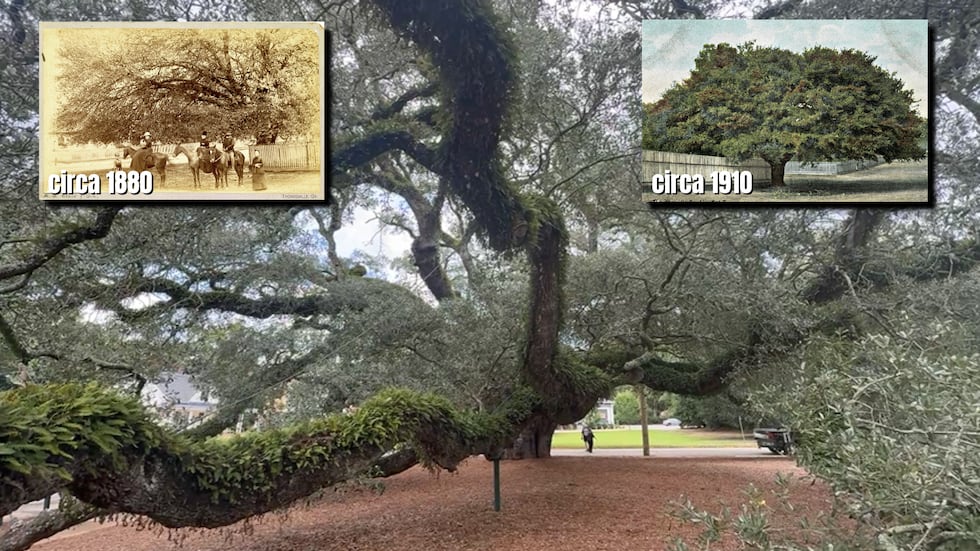
Rotter said the museum has photographs of the tree dating to the early 1880s.
As Thomasville promoted itself as a health resort after the Civil War, visitors took walks and carriage rides through town. The unusually large oak, then standing in the front yard of a private home, became a memorable stop for tourists. By the late 1800s, it was appearing in promotional materials, postcards and visitor guides under names including the “great oak,” “old oak” and “big oak,” Rotter said.
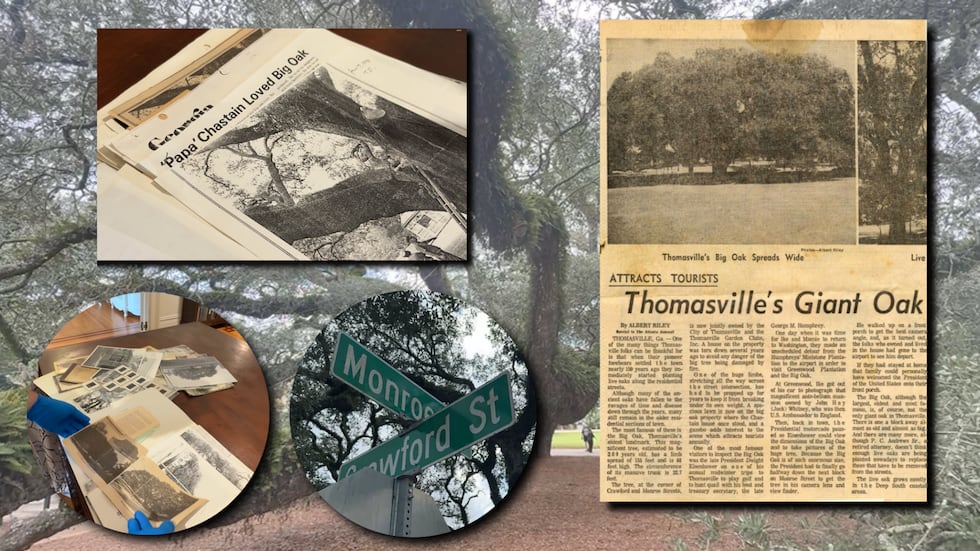
In 1936, the tree joined the Live Oak Society, a registered organization for the region’s oldest live oaks; it’s still a member today. Rotter said it is likely the third-oldest known live oak east of the Mississippi River, behind South Carolina’s Angel Oak.
“There are bigger trees, there are older trees, but there are not better marketed trees than Big Oak,” Rotter said.
The tree has also served as a gathering place through pivotal moments in local history. During the Vietnam War, residents tied yellow ribbons around its trunk.
Separating lynching claims from documented history
The tree’s long life has also produced local stories, including a claim that a lynching occurred at the Big Oak.
Rotter said he has found no documented evidence connecting a lynching or other acts of racial violence tied to the tree.
He said that does not erase the history of racial terror in Thomas County, where researchers have documented between eight and 10 lynchings, including the deaths of Willie Kirkland and Lacey Mitchell, who were lynched in the 1930s.
Rotter worked with researchers connected to the Equal Justice Initiative as they investigated documented cases in the county.
“If evidence ever turns up that there was a lynching at the Big Oak, you learn about new things all the time,” Rotter said. “But of course, I can’t tell a story about something for which there’s no evidence.”
Rotter said the focus should remain on identifying and honoring the documented victims of lynching in Thomas County.
A tree with environmentalist critics
The tree also has its critics. Rotter said some environmentalists have pointed to the tree as an example of hypocrisy, arguing the city celebrates one iconic oak while permitting the removal of trees elsewhere for development, including recent debate over trees at Paradise Park.
Rotter said the History Center doesn’t take positions on the disputes.
“What we really try to do is present information,” he said, and the museum lets residents draw their own conclusions.
A downtown centerpiece for tourism
Today, the Big Oak remains part of Thomasville’s downtown experience. Visitors can call a number posted near the tree to activate a remote camera across the street and take a keepsake photo. The site also serves as a backdrop for proposals and picnics.
“The Big Oak is such a beautiful part of our downtown,” Katie Ketchum, Thomasville’s Main Street director, said. “People do proposals here. They do have picnics. It offers so much shade and cover.”
City officials said preserving the tree is about maintaining a living landmark that has grown alongside, and long before, Thomasville’s history. They say the goal is simple: keep the Big Oak standing for the generations still to come.
The city of Thomasville continues its bicentennial celebrations. The city’s website lists the remaining events for the year.
Have a news tip or see an error that needs correction? Let us know. Please include the article’s headline in your message.
To stay up to date on all the latest news as it develops, follow WALB on Facebook, TikTok, Instagram, and X. For more south Georgia news, download the WALB News app and add WALB as a preferred source on Google.
Copyright 2026 WALB. All rights reserved.
News Source : https://www.walb.com/2026/08/27/whats-keeping-thomasvilles-big-oak-alive-after-more-than-300-years/
Other Related News
08/28/2026
ALBANY Ga WALB The Albany Police Department APD arrested Marquis DeSean Green 22 in conne...
08/28/2026
SYLVESTER Ga WALB WALBs Aaron Meaux and McKenzie Blaze are hosting Your Hometown Tailgate...
08/28/2026
ATLANTA Ga Atlanta News FirstWTOC State regulators have officially approved a contract fo...
08/28/2026
MACON Ga WPGA - Sen Jon Ossoff D-Georgia called on Rep Mike Collins R-Georgia to answer al...
08/28/2026
ATLANTA Ga Atlanta News First Georgia economic leaders say the states businesses are bein...

Follow

Download Our App


Copyright 2022 © Albany Metro Community. All Rights Reserved