


Published on: 02/11/2026


Description
VALDOSTA, Ga. (WALB) - A proposed data center near a Valdosta neighborhood is sparking concern among residents, but opponents say the issue stretches far beyond Lowndes County. From South Georgia to rural towns across the country, communities are questioning what large-scale data center developments could mean for their water, power and long-term sustainability.
Opposition groups argue that data centers consume massive amounts of water to cool equipment, placing added strain on local water supplies. While companies point to economic development, critics say rural towns many already facing drought conditions and aging infrastructure may not be equipped to handle that level of demand.
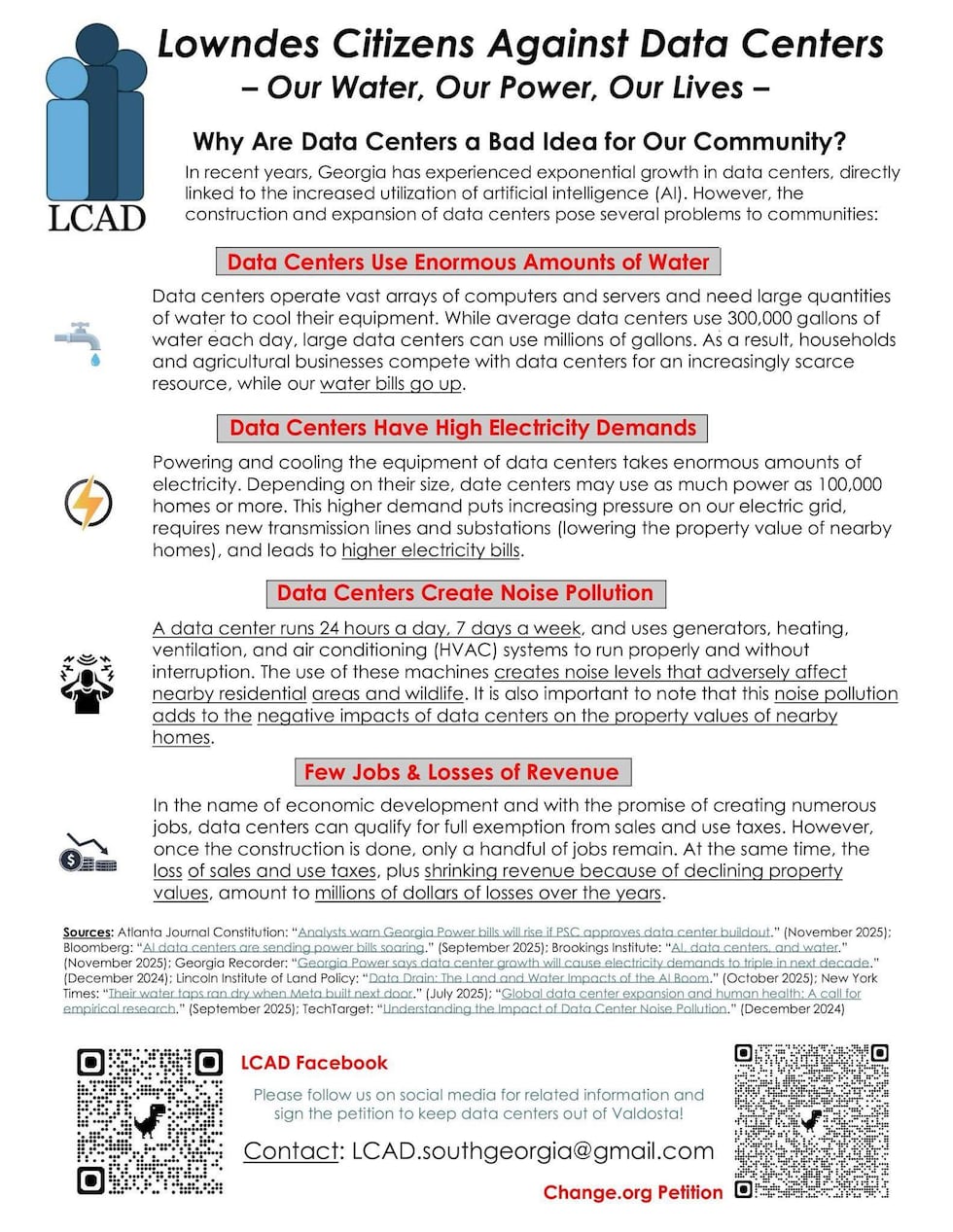
Residents in Lowndes County recently voiced concerns about a proposed data center planned west of the Foxborough subdivision. Some say the project reflects a growing trend in rural areas, where large developments are often drawn by cheaper land, tax incentives, and proximity to infrastructure but leave communities dealing with the consequences.
Data centers house data and power much of what people do online, and they continue to move into rural areas. Landowner Marvin Peavy said he recently learned that a data center could be built near his farm, which sits on the county line between Irwin and Tift counties. Peavy said he was never contacted about the project.
Peavy said he is especially concerned about water usage, noting that data centers can use more than a million gallons of water a day to cool equipment. He said that demand could put local wells and aquifers at risk.
Peavy added that he relies on a private well and does not have access to county water. He said he worries that increased strain on the aquifer could leave residents without clean, usable water, pointing to other communities where residents say water quality and pressure declined after data centers moved in.
Peavy said he also believes the potential water loss could devastate farming, wildlife and recreation across the region. Peavy said streams that feed his lake support fishing and wildlife, and that if those water sources dry up, the investment he has made in his land could be lost.
Residents said they feel shut out of the decision-making process and argued that when a majority of people oppose a project, their concerns should carry more weight than potential profits.
Peavy questioned what data centers truly bring to rural communities, saying the facilities are brightly lit, disruptive to wildlife and often provide only a handful of long-term jobs.
While data centers are often marketed as job creators, critics argue that once construction is complete, only a small number of permanent positions remain. At the same time, rural governments may lose tax revenue due to exemptions, while facing increased costs tied to infrastructure upgrades and public services.
The debate has also reached the state level. Governor Brian Kemp recently vetoed House Bill 1192, which would have paused Georgia’s sales tax exemption for data centers. Peavy said he believes rural areas are being targeted for their land, water and resources.
Opposition to data centers is growing nationwide, with more than 140 activist groups across 24 states pushing back against new projects. In 2025, the city of St. Charles, Missouri passed the nation’s first year-long ban on data center construction, and several Georgia cities, including parts of Atlanta, approved restrictions or moratoriums. Similar opposition in other states has already delayed or canceled billions of dollars in projects.
Valdosta resident Julian Connell said he shares those concerns, pointing to existing issues in the city.
Connell said Valdosta already struggles with trash and environmental problems, and he said he worries that adding a massive development could worsen pollution and create challenges the city is not prepared to manage.
Residents said the fight over data centers is part of a much larger national debate, and many said they feel they are up against millions of dollars in development while their voices go unheard by local and state leaders.
Community members are now urging elected officials to slow the process, ask more questions and consider the long-term effects on rural towns that rely heavily on shared resources like water, land and power.
Have a news tip or see an error that needs correction? Let us know. Please include the article’s headline in your message.
To stay up to date on all the latest news as it develops, follow WALB on Facebook and X (Twitter). For more South Georgia news, download the WALB News app from the Apple Store or Google Play.
Copyright 2026 WALB. All rights reserved.
News Source : https://www.walb.com/2026/02/10/rural-communities-raise-concerns-data-centers-expand-across-georgia-beyond/
Other Related News
02/10/2026
CAIRO Ga WALB - The City of Cairo officially broke ground on the new Holder Park Pavilion ...
02/10/2026
WALB is working to produce a video for this story In the meantime we encourage you to watc...
02/10/2026
NASHVILLE Ga WALB - Nashville Police are warning residents about a bond scam targeting pe...
02/10/2026
DECATUR COUNTY Ga WALB - Georgia State Patrol GSP has released preliminary details followi...
02/10/2026
TODAYTOMORROW- Warming up into the low 70s today with clouds breaking for more sunshine th...

Follow

Download Our App


Copyright 2022 © Albany Metro Community. All Rights Reserved