


Published on: 12/15/2025


Description
ALBANY, Ga. (WALB) - A new digital Resistance Trail spanning more than six Southwest Georgia counties reveals that Albany was the site of the second-largest single sale of enslaved Africans in U.S. history.
The Dougherty County Commission, alongside Clennon King, unveiled the 22-stop interactive trail that uses short films, QR codes, and location-based storytelling to reveal Black history across Dougherty, Mitchell, Baker, Terrell, Calhoun, and Crisp counties.
Although this is the third courthouse at this location, the history remains the same. In the late 1800s, on the courthouse steps, Albany saw the second-largest single sale of enslaved Africans in the United States.

Murder led to massive slave sale
The sale stemmed from a murder between two white men; Joseph Bond, a planter and slave owner, and Lucious Brown, an overseer Bond had fired.
“This stems from a murder. Two white men fighting with each other. One is a planter; one is an overseer that used to work for him - he had fired him,” said Clennon King, Historian with Resistance Trail of Southwest Georgia. “They got into it about a dispute. And the planter went in an attacked him with a stick, and the overseer turns around takes his gun and shoots and kills him. At this point, he’s one of the largest enslavers in the state, and now he’s got to liquidate his estate.”
The murder happened about seven miles from what is now Southwest Georgia Regional Airport, near Leary Road and 8 Mile. Bond owned seven plantations, and after his death, his wife was unable to maintain them, forcing the liquidation of the entire estate, including over 500 slaves.
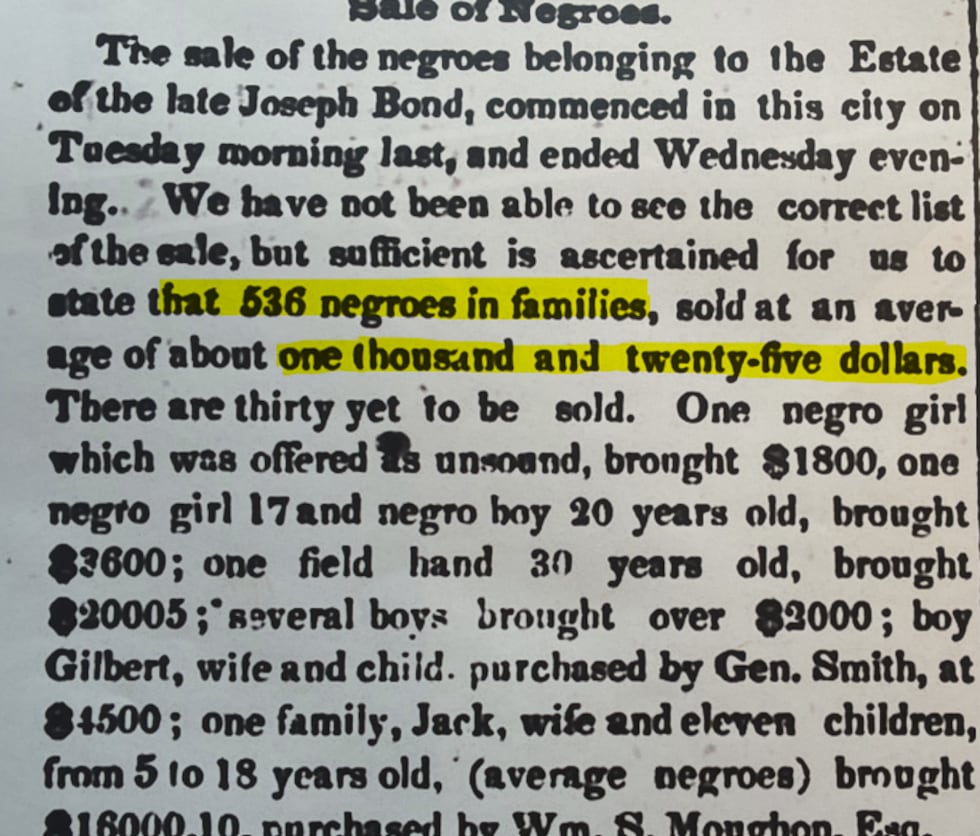
Original sale advertisement preserved
Historical records show the original sale advertisement: “I will offer for sale before the courthouse door in Albany, Georgia, on Tuesday, the 3rd day of January. This is what it looked like; this is the original one, we were sold here.”
The sale lasted two days. Five hundred thirty-six people were sold at an average price of $1,000 each.
The names and details of those sold have been preserved, showing the human cost of the liquidation.
“Yes, he owned them all. There are all these names of all these people, men, women, and children. It’s very specific. There’s Charles, Larkin, Betsy, his wife, their children,” said King.
The records show specific prices: “17-year-old girl, 20-year-old boy, 36-hundred dollars, 1 field hand,” demonstrating how enslaved people were valued as property.
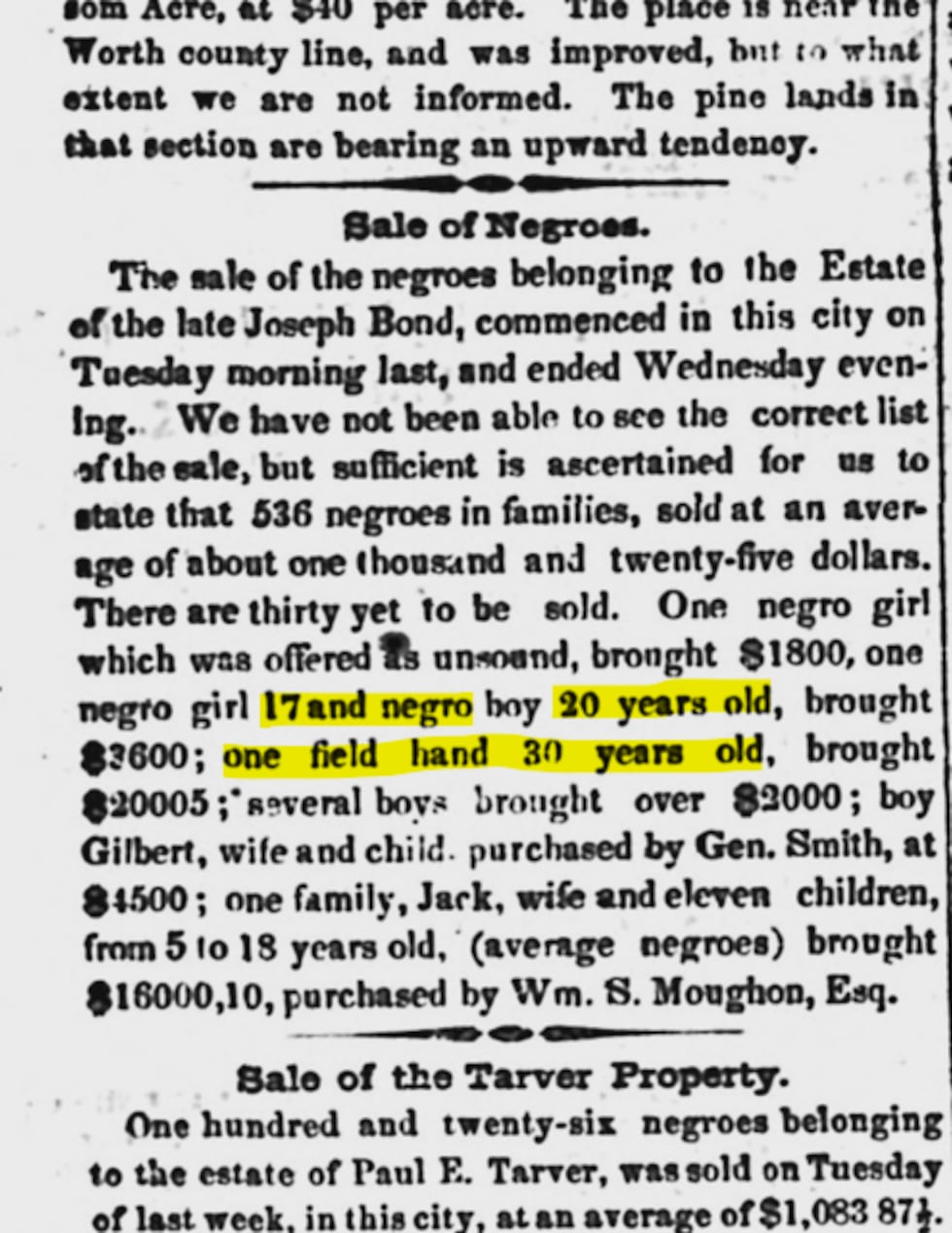
“Yes, the vast majority of these people that were sold were between 15 and 30,” King said.
Slave owners wanted Africans who were fit and fertile to maintain cotton production, which remains the foundation of South Georgia’s economy today as agribusiness.
Wealth built on enslaved labor
The sale and cotton economy created enormous wealth for white plantation owners.
“Anything that came out of her womb, basically, a black woman’s womb, was his property, and he only became that much wealthier. And at one point this was the wealthiest per capita county in the entire state - wealthier than Atlanta or any of these places,” King said. “Black folk picking cotton here, made its way there, and made people rich and built America.”
King emphasizes the positive legacy that emerged from this painful history.
“We’re a resilient people, a talented people, we built this country, and we did it free of charge, and I think we’re capable of anything,” King says. “SWGA produces a lot, there’s a lot to be proud of, and that’s what these stories are all about, so that people understand it. Sometimes resistance looks like leaving, sometimes it looks like staying and fighting, sometimes it looks like coming in and helping people here.”
Digital access to hidden history
Visitors can access the trail by scanning QR codes at locations throughout the region. Each code leads to short films that tell the stories of resistance, resilience, and cultural achievement.
One of the great things is that you can learn so much more about the history of Southwest Georgia just by going on your phone. When you go to a location, you’ll see a QR Code at one of the locations, and then it’ll take you to a video.
The digital trail explains why Albany was chosen as a commercial epicenter, citing the cotton gin, river access, and the Indian Removal Act. The Flint River connected Georgia to Florida’s port in Apalachicola and as far north as Canada.
Cultural heritage included
The trail also highlights cultural figures like Ray Charles, Denzel Washington, Ketanji Jackson, and The Isley Brothers, showing visitors their exact childhood locations through 2:30 films triggered on phones. The digital trail lets people discover the roots of that excellence and the resistance that made it possible.
The trail provides residents and visitors with access to how Black labor, culture, and resilience shaped Southwest Georgia. This digital trail will be available in 2027.
Have a news tip or see an error that needs correction? Let us know. Please include the article’s headline in your message.
To stay up to date on all the latest news as it develops, follow WALB on Facebook and X (Twitter). For more South Georgia news, download the WALB News app from the Apple Store or Google Play.
Copyright 2025 WALB. All rights reserved.
Other Related News
12/15/2025
ALBANY Ga WALB - A national report recently put the spotlight on the Phoebe Putney Health ...
12/15/2025
ALBANY Ga WALB - An Albany Police APD press meeting confirmed that 41-year-old Allen Plumm...
12/15/2025
ATKINSON COUNTY Ga WALB - Students in a Pearson classroom are learning that Christmas isnt...
12/15/2025
ALBANY Ga WALB - A local Albany group called Dem Bois is giving families in need 500 cash ...
12/15/2025
ALBANY Ga WALB - Nearly three in four Americans say they fell short of their saving and sp...

Follow

Download Our App


Copyright 2022 © Albany Metro Community. All Rights Reserved